
Behind the Scenes of the NATO Ankara Summit: Tensions Underlying the Unity Declaration
July 10, 2026
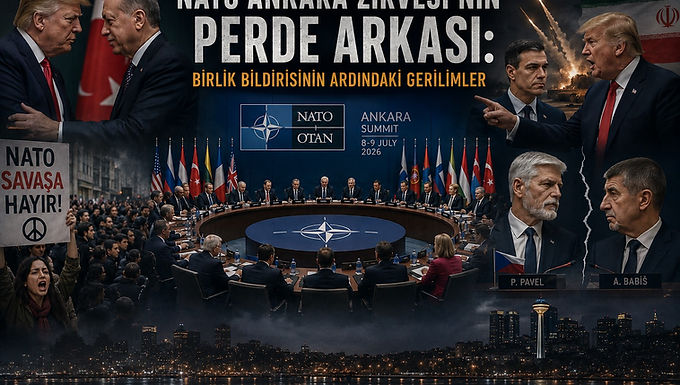
The official statement of the Ankara Summit was short, controlled, and conveyed a message of unity. However, the diplomatic scene of the summit was far more dynamic. The leaders' attitudes, the protocol images, and their statements to the press revealed serious tensions within NATO, not only at the strategic level but also at the personal and political level.
The most striking event was Trump's announcement during the summit that the ceasefire with Iran was "over." While NATO's main agenda was defense capacity, Ukraine, and alliance solidarity, the US President's announcement of new attacks against Iran in Ankara overshadowed the summit's collective agenda. This statement revealed the difference between NATO's official image of unity and Washington's unilateral crisis management.
The second significant tension arose over Spain. Trump targeted Spain for its defense spending and its stance on Iran policy; he even said that the US should cut off trade with Spain. This statement went far beyond the usual diplomatic language used against an ally at a NATO summit. Despite this, Pedro Sánchez later portrayed his meeting with Trump as a "cordial" encounter. Therefore, there was a crisis on stage, but controlled diplomatic damage management behind the scenes.
A third unusual event came from the Czech Republic. The dispute over representation between President Petr Pavel and Prime Minister Andrej Babiš was brought to Ankara. The fact that the two leaders prepared separately for the summit and made their domestic political rivalry visible on the NATO platform showed that the debate over defense spending within the alliance was no longer just between countries, but had become a contentious issue within those countries' domestic politics.
The fourth noteworthy topic was the Greenland issue. Trump's renewed assertion of US control over Greenland was quite unusual in terms of sovereignty sensitivities within NATO. This is because the issue concerns not external actors like Russia or China, but directly Denmark, a NATO ally. Therefore, the issue became a symbolic crisis highlighting how fragile trust within the alliance can become.
The Erdoğan-Trump image was also one of the symbolic dimensions of the summit. President Erdoğan's close attention to Trump can be interpreted as an attempt to open a new chapter in Turkey-US relations. Indeed, during the summit, issues such as the F-35 matter, defense industry sanctions, and Turkey's inclusion in the European security architecture came to the forefront. In this respect, the Ankara Summit was not only a NATO Summit for Turkey, but also a platform for repositioning relations with Washington.
Spanish Prime Minister Pedro Sánchez was in Ankara; however, it was reported that his wife, Begoña Gómez, could not attend the summit due to a court ruling. This detail created a small but striking image in diplomatic protocol: the floral welcome protocol prepared for her was rendered meaningless.
News reports indicated that Trump and Italian Prime Minister Meloni ignored each other during the group photo. This image was linked to Italy's distance from American military demands in the context of the Iran-Iraq conflict. This simple incident can be seen as a simple display of coolness between the two leaders, or as one of the early signs of differences in the foreign policies of the two countries.
One of the most striking aspects of the summit was the extraordinary security measures taken by Turkey prior to the meeting, which drew criticism for exceeding the necessary security requirements. City life was also reorganized to accommodate the summit. Numerous main arteries and connecting roads were closed in Ankara, while protest bans, detention operations, administrative regulations targeting public employees, and measures affecting business activities sparked public outrage.
Undoubtedly, a NATO summit attended by dozens of heads of state and government requires extraordinary security measures. However, the combination of these security measures with widespread bans on demonstrations, preventative detentions, and restrictions that significantly disrupted daily life drew criticism. Thus, one of the summit's striking contradictions emerged: while NATO leaders reiterated their rhetoric of democracy, shared values, and rules-based order in Ankara, the space for peaceful opposition to the summit was significantly narrowed.
When all these events are considered together, two distinct faces of the Ankara Summit emerge. On the official side, NATO attempted to demonstrate unity on issues such as support for Ukraine, defense industry, artificial intelligence, and deterrence. Behind the scenes, there were Trump's unpredictable outbursts, debates over intra-European defense spending, the rapprochement between Turkey and the US, the Spanish crisis, the Greenland controversy, the dual representation problem in the Czech Republic, and tensions between the US and Italy. Therefore, the Ankara Summit can be summarized with this sentence: It tried to appear strong in NATO decisions; however, the leaders' behavior showed that the alliance's political psychology is quite fragile.TO kararlarında güçlü görünmeye çalıştı; fakat liderlerin davranışları ittifakın siyasal psikolojisinin oldukça kırılgan olduğunu gösterdi.
Oktay BINGOL